A competitive gaming name has a different job from an ordinary username. In a casual game, almost any funny, decorative, or unusual name can work. In ranked matches, tournaments, streams, and team environments, your name becomes part of how other players identify you.
The right style should therefore do more than look impressive. It should be easy to recognize in a scoreboard, simple enough to say over voice chat, distinctive enough to remember, and flexible enough to work across different platforms.
This is why choosing a competitive gaming name is not simply about finding the fanciest font or the most intimidating word. The best style depends on the kind of identity you want to build and how the name will actually be used.
Start With Your Competitive Identity
Read also: → Gaming Names Hub — Stylish Usernames for Every Game
Before choosing a name style, think about what you want the name to communicate.
A competitive player might want to appear:
- Professional
- Aggressive
- Tactical
- Minimalist
- Mysterious
- Fast and energetic
- Calm and confident
- Funny but memorable
- Futuristic
- Team-oriented
There is no single style that works for every player.
A short name such as Vex creates a very different impression from ShadowHunter, even though both can be used for competitive gaming.
The first feels compact and minimalist. The second creates a stronger thematic identity.
Start by deciding what kind of impression you want the name to create, then choose words and styling that support it.
Why Readability Matters More in Competitive Gaming
Competitive usernames appear in situations where players do not have much time to study them.
Your name may appear in:
- Kill feeds
- Scoreboards
- Team lists
- Match results
- Leaderboards
- Tournament brackets
- Chat
- Friend requests
- Stream overlays
- Social media posts
A complicated name can become difficult to recognize when it appears briefly or at a small size.
For this reason, competitive names generally benefit from a clear visual structure.
A player should ideally be able to look at your name and recognize it immediately rather than spending time figuring out which characters you used.
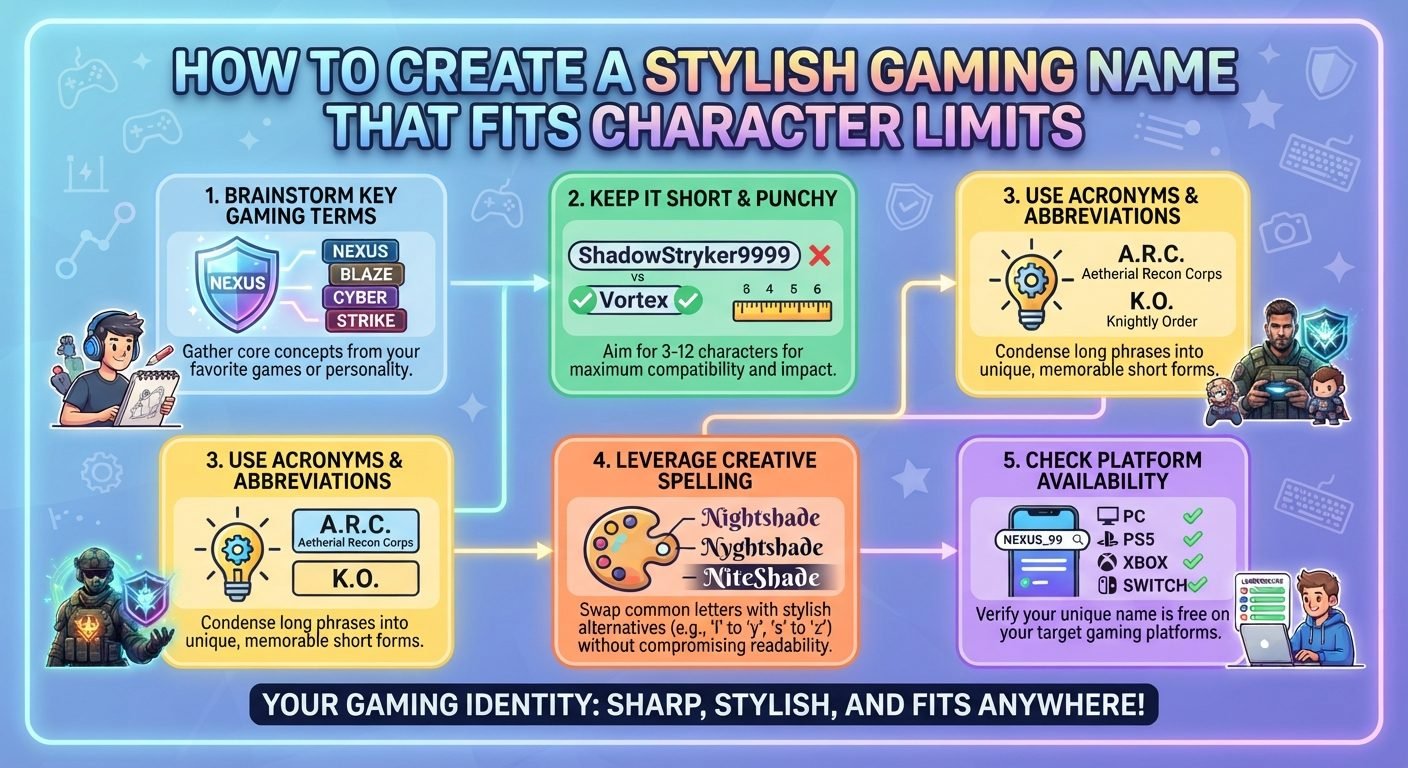
Choose a Short Core Name
One of the strongest foundations for a competitive name is a short core word.
Examples include:
VexRiftNovaFrostEchoDriftVoltRavenBlazeOrbit
Short names are easier to remember and can work in more situations.
They also leave room for additional elements such as a team tag or a small stylistic detail.
For example:
Vex
can remain simply Vex, while another player might develop it into:
VexR
or:
VexNova
The important thing is to protect the recognizable core of the name.
The Minimalist Competitive Style
A minimalist name uses very little decoration.
Examples:
VexRiftNovaKairoFrostDrift
This style is useful when you want the name to feel clean and professional.
Minimalist names also tend to be easier for commentators, teammates, and viewers to pronounce.
If your goal is to build a recognizable identity over time, simplicity can be more useful than excessive decoration.
A short name that people remember easily can become associated with you through repeated use.
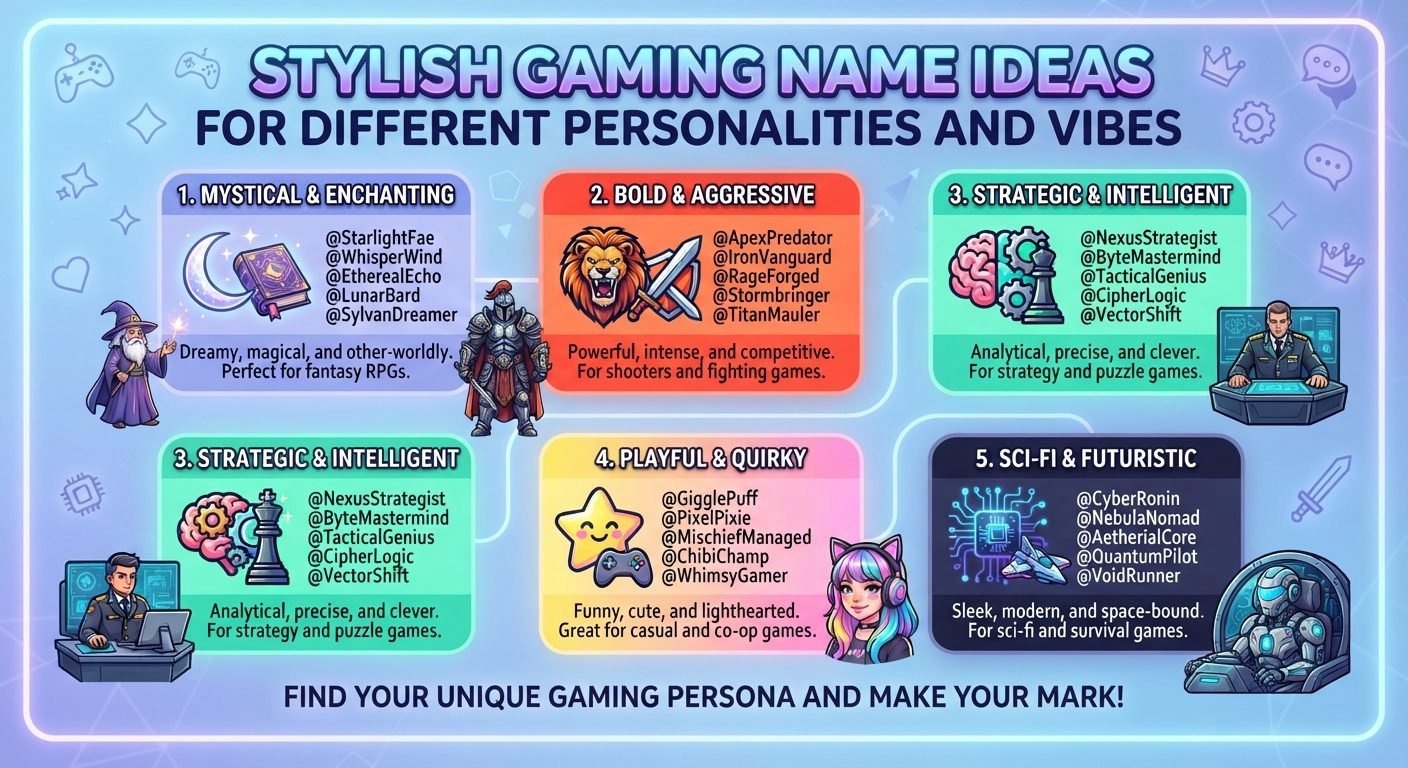
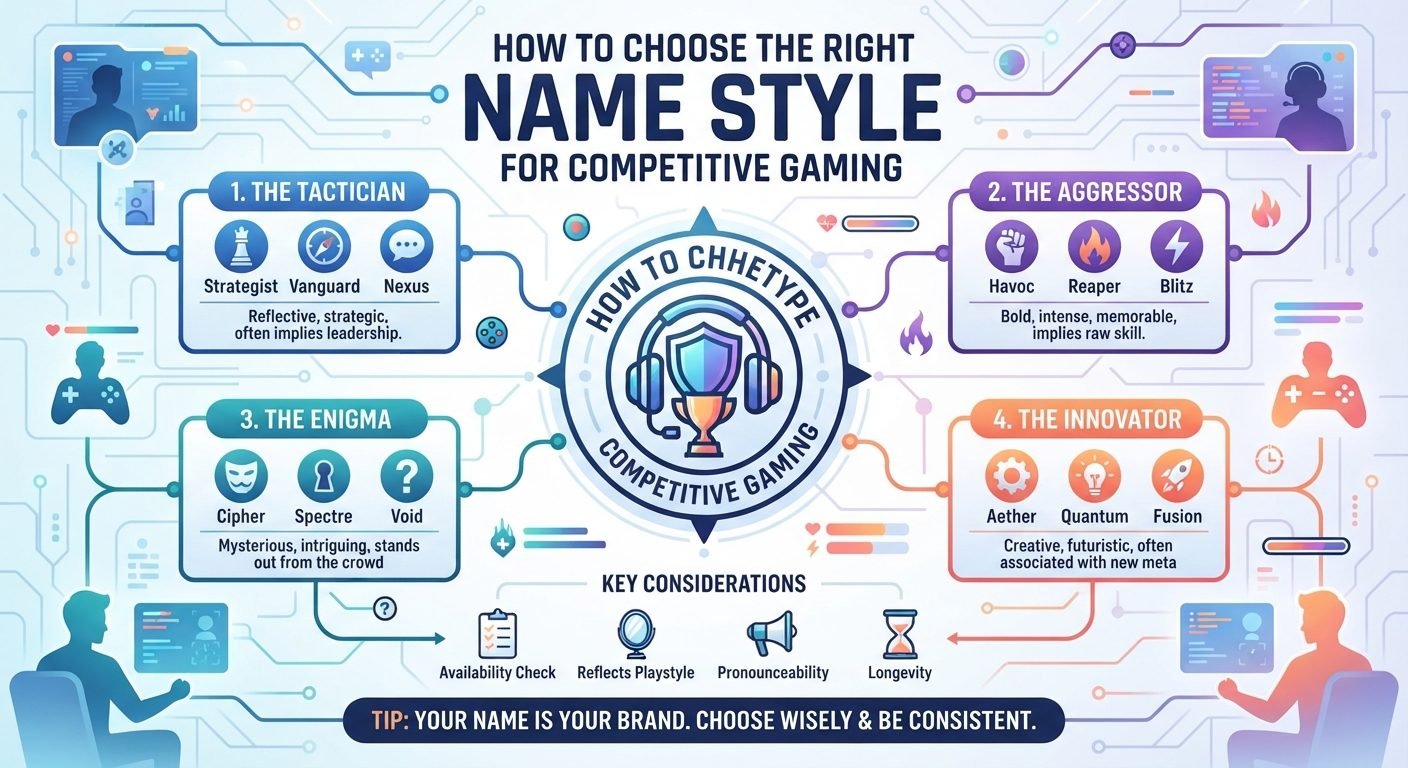
The Aggressive Style
Some competitive players prefer names that sound powerful or intense.
Common themes include:
- Weapons
- Predators
- Storms
- Fire
- Darkness
- Strength
- Speed
Examples:
IronFangStormRiftNightFuryRageCoreViperXBlazeRush
The important point is not to make the name as aggressive as possible.
A name containing several threatening words can become generic. DarkShadowKiller may communicate aggression, but it is much harder to distinguish from countless similar gaming names.
A shorter concept such as RiftFang can communicate a similar mood while remaining more distinctive.
The Tactical Style
If your gaming identity is based around strategy, precision, or competitive discipline, a tactical style may fit better.
Consider words related to:
- Precision
- Control
- Vision
- Reconnaissance
- Movement
- Timing
- Positioning
- Strategy
Examples:
VectorCrosshairLockstepSightlineZeroPointGridlockPulse
These names do not need to sound aggressive. Their identity comes from the concept behind the word.
A tactical name can work particularly well for players who want a serious rather than flashy appearance.
The Futuristic Style
A futuristic name can work well for games with science-fiction, technology, or cyber themes.
Examples include:
NovaCoreCyberRiftNeonPulseQuantumXVoidByteOrbitZero
The trick is to avoid filling the name with unnecessary technology-related words.
A name does not become more futuristic simply because it contains words such as Cyber, Tech, AI, and X all at once.
Choose one clear concept and build around it.
For example, NovaCore is easier to remember than a much longer name such as CyberQuantumTechX.
The Dark or Mysterious Style
A darker style can create an identity around mystery rather than direct aggression.
Useful themes include:
- Night
- Shadow
- Ghost
- Void
- Raven
- Eclipse
- Phantom
- Mist
Examples:
VoidRavenNightRiftGhostNovaEclipseXShadowVale
This style works best when the name remains readable.
Decorative gothic lettering can sometimes complement a dark identity, but the underlying word should still be recognizable.
The Funny Competitive Style
Competitive gaming does not always require a serious name.
A funny username can become highly memorable precisely because it contrasts with the seriousness of the match.
Examples:
PotatoAimLateAgainTinyTankNoScopeChefLagWizardLostKeyboard
The main consideration is whether the humor will continue to work over time.
A joke based on a temporary meme may become outdated quickly. A simple concept can remain amusing for much longer.
Funny names also need to remain appropriate for the communities and competitions where you plan to use them.
The Clean Esports-Style Name
If you are interested in tournaments or building a recognizable competitive identity, consider a name that could comfortably appear on:
- A tournament bracket
- A team roster
- A scoreboard
- A jersey
- A stream overlay
- A social media profile
- A video thumbnail
This does not mean you need to copy the naming style of professional players.
Instead, ask whether your name can function as a recognizable label.
For example:
Vex
Rift
Kairo
Nova
Drift
These names are visually simple and can be incorporated into different forms of branding.
The same principle works with slightly longer names such as NovaRift or FrostByte.
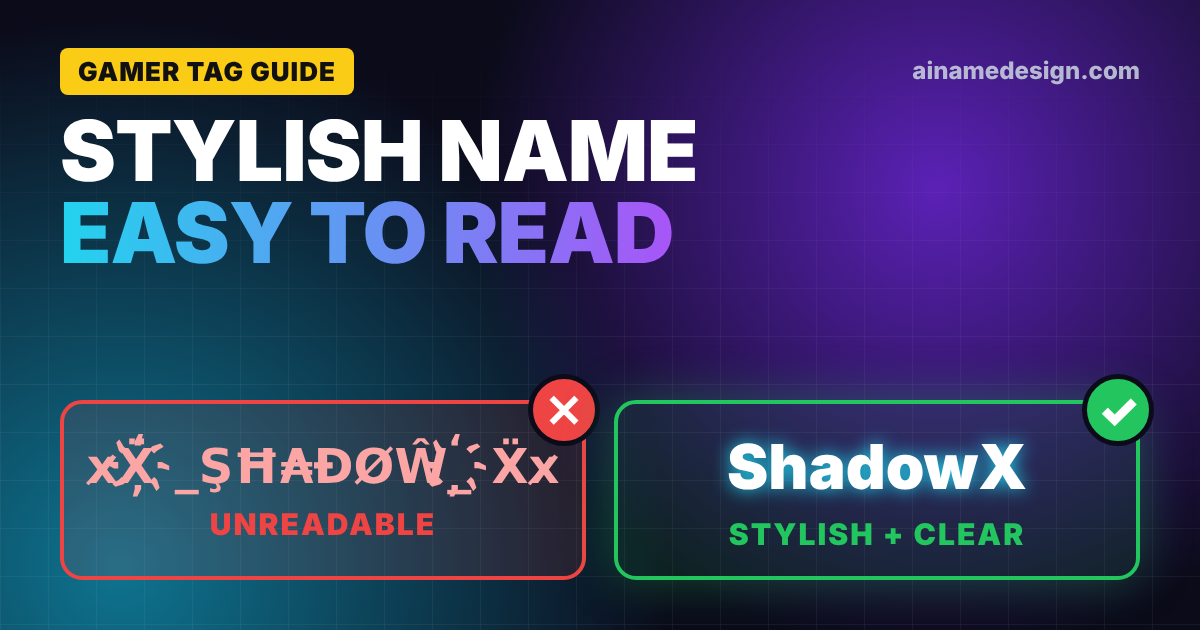
Be Careful With Fancy Fonts
Stylized Unicode characters can make an ordinary name look dramatically different.
However, decorative characters have practical limitations.
A character that looks good in a browser may not display correctly in every game, device, or interface. Some platforms restrict the characters that can be used in names, while others have specific length and formatting rules.
For example, Epic Games currently states that its display names must be between 3 and 16 characters and cannot contain certain categories of offensive or private information.
Other games have different requirements.
That means you should always check the specific game's current naming rules instead of assuming that a particular font or symbol will work everywhere.
For competitive use, ordinary letters should remain the foundation whenever possible.
Use Symbols as Decoration, Not as the Name
Symbols can add personality.
For example:
★Vex
Vex★
『Nova』
These designs keep the main name visible.
The problem begins when the symbols become more noticeable than the name itself.
A username such as:
꧁༺★VΞX★༻꧂
may look elaborate, but it can be difficult to read, type, remember, or reproduce.
For competitive gaming, ask whether the decoration actually improves recognition.
If removing the symbols makes the name clearer without making it boring, the simpler version may be more practical.
Avoid Overusing Numbers
Numbers can distinguish a username when the preferred name is unavailable, but long random sequences can make a competitive name look temporary.
Compare:
Vex7
with:
Vex583927
The first is much easier to remember.
If your chosen name is already taken, consider changing the structure before adding a large number sequence.
For example:
Vex
could become:
VexCoreVexRiftVexNovaVexRush
This creates a more intentional identity.
Think About Team Tags
Competitive gaming often involves teams, clans, or organizations.
If you eventually join a team, your personal name may be displayed alongside a team tag.
For example, a structure might look like:
[TAG] Vex
or:
TAG Vex
The exact format depends on the game or tournament.
This is another reason to keep your core name reasonably short. A long personal username can become awkward once a team identifier is added.
A compact name gives you more flexibility.
Make the Name Easy to Say
Competitive gaming involves communication.
During a match, teammates may need to call your name quickly.
A name such as Vex is easy to say.
A complicated username containing several decorative characters may force teammates to invent a nickname for you simply because they cannot pronounce the original.
That is not necessarily a problem, but it means the elaborate styling is not doing much useful work.
Before choosing a name, say it aloud several times.
If you can naturally imagine a teammate saying it during a fast match, that is a good sign.
Consider How Casters Would Pronounce It
If you plan to compete publicly, think beyond your immediate group of friends.
A competitive name may eventually appear in:
- Tournament broadcasts
- Videos
- Match recaps
- Leaderboards
- Social media
- Community discussions
A name that can be pronounced easily is more practical in these situations.
You do not need to choose a conventional name. Unusual names can work extremely well. The important distinction is between unique and unintelligible.
A unique name gives people something to remember.
An unintelligible name gives them something they cannot easily repeat.
Avoid Copying Established Players
It can be tempting to imitate the naming style of famous players.
There is nothing wrong with being inspired by a general naming approach, but your actual identity should be your own.
Avoid names that could reasonably make people think you are impersonating another player or established gaming personality.
A similar-looking name can also make it difficult to build your own identity.
Instead of copying a recognizable name and changing one character, take inspiration from the qualities you like:
- Short length
- Simple spelling
- Strong sound
- Unusual word
- Memorable concept
Then create something independent.
Match the Name to Your Game
Different games create different naming environments.
A name that feels appropriate in a fantasy RPG may look strange in a tactical shooter.
Consider the atmosphere of the game.
Tactical shooters
Names can work well when they are short, precise, and easy to identify.
Examples:
VectorSightRiftPulse
Battle royale games
There is often more room for personality.
Examples:
StormFoxNovaRushLastOrbit
Fantasy games
Names can incorporate mythology, magic, nature, or fictional themes.
Examples:
MoonWardenAshRavenFrostMage
Racing games
Speed and movement themes can fit naturally.
Examples:
ApexDriftVelocityNightLap
These are only style directions. The best choice depends on your own identity and the particular game.
Decide Whether You Want a Personal Brand
There is an important difference between a temporary gaming username and a long-term gaming identity.
If you change names frequently, you can experiment more freely.
If you want people to recognize you across years of competitive gaming, consistency becomes more important.
A long-term name should ideally be:
- Easy to spell
- Easy to pronounce
- Distinctive
- Flexible
- Suitable for different games
- Appropriate for public use
- Easy to display visually
You may eventually use the same identity on gaming platforms, streaming services, social networks, and other communities.
That makes the original choice more significant.
Check Availability Before Designing the Final Style
Do not spend an hour creating a decorative version of a name before checking whether the underlying name is usable.
First create several plain candidates.
For example:
VexVexRiftVexCoreVexNovaVexPulse
Then check which versions are available on the platforms that matter to you.
Once you have a viable name, decide whether it needs additional styling.
This prevents you from becoming attached to a decorative version that cannot actually be used.
Test the Name at Small Size
This is one of the most important tests for competitive gaming.
Open the name in a small text environment or preview it at a size similar to an in-game scoreboard.
Look at it from a short distance.
Can you still recognize the word?
If the answer is yes, the design is probably working.
If the name becomes a blur of symbols or unusual letters, simplify it.
Remember that competitive names are frequently seen in motion. A design that requires careful inspection is not ideal for a fast match.
Create a Plain Version Too
It is useful to have a basic version of your name even if you prefer a styled version.
For example:
Styled: ★NovaRift★
Plain: NovaRift
The plain version gives you an alternative when:
- A game rejects special characters
- A website has stricter username rules
- A tournament system does not display certain characters
- Someone needs to type your name
- You need a clean social media handle
A strong competitive identity should survive without decorative elements.
Think About Longevity
Gaming interests change.
You might spend several years playing one game and then move to another. You might also transition from casual gaming into ranked play, streaming, content creation, or tournament competition.
A name that is too specific can become restrictive.
For example, a username built around one particular weapon, character, or temporary game mechanic may make less sense after you move to another title.
A broader name gives you more freedom.
Instead of:
OnlySniperCOD
you might choose something like:
FrostRift
The second can follow you into different games without becoming outdated.
A Simple Method for Choosing Your Style
If you are unsure which style suits you, use this process.
Step 1: Choose three words
Write down words that represent the identity you want.
For example:
- Fast
- Dark
- Precise
Step 2: Find related words
For fast, consider:
- Rush
- Swift
- Velocity
- Dash
For dark:
- Shadow
- Void
- Night
- Eclipse
For precise:
- Vector
- Sight
- Aim
- Zero
Step 3: Combine them
You might create:
VoidDashNightVectorShadowRushZeroVelocity
Step 4: Remove unnecessary parts
Choose the combination that is easiest to say and remember.
Step 5: Test the plain version
If the name already looks good without symbols, keep it simple.
Step 6: Add one small stylistic element if needed
A single symbol or capitalization pattern may be enough.
Step 7: Test it in the actual game
Check readability, compatibility, and character restrictions before committing.
Common Competitive Gaming Name Mistakes
Choosing style over readability
A beautiful name is not useful if nobody can read it.
Making the name too long
Long names take more time to recognize and may become awkward with team tags.
Using random numbers
Large number sequences are difficult to remember.
Adding too many symbols
Decoration can hide the actual name.
Using confusing letter substitutions
Replacing letters with similar-looking numbers or symbols can create spelling problems.
Copying another player's identity
A similar name can create confusion and make your own identity less distinctive.
Choosing a temporary trend
A name based on a short-lived meme may age poorly.
Ignoring platform restrictions
A name generator cannot guarantee that every game will accept its characters.
Forgetting voice communication
If teammates cannot pronounce the name, it becomes less useful as a competitive identity.
Final Checklist
Before choosing your final competitive gaming name, ask:
- Is the core name short enough?
- Is it easy to pronounce?
- Can players recognize it quickly?
- Can teammates type it without difficulty?
- Does it look good without special characters?
- Does the style fit the identity I want?
- Does it match the game I play?
- Will it work with a team tag?
- Does it remain readable at a small size?
- Does the game support the characters I am using?
- Am I avoiding unnecessary personal information?
- Is the name different enough from established players?
- Will the name still make sense if I change games?
- Would I be comfortable using it publicly for several years?
If the answer is mostly yes, the name is likely practical as well as stylish.
Read also: → How to Use Gaming Symbols in Usernames (Full Guide)
Frequently Asked Questions
What name style suits competitive play?
Short and clean. A competitive name is read in a fraction of a second on a scoreboard or in a kill feed, so anything that needs a second look is working against you.
Do fancy fonts work in competitive games?
Often not. Competitive titles are the strictest about character filtering, and a name that renders as boxes for teammates is worse than a plain one that everybody can read.
How long should a competitive name be?
Short enough to leave room for a team tag. The tag and the name share one field, so a long core name forces a choice between the two later.
Should the name be easy to pronounce?
Yes, if you ever expect it said aloud. A name a caster or a teammate cannot pronounce gets shortened to something you did not choose.
Is copying an established player's name a problem?
It costs you the thing the name exists for. A name close to a known player's reads as an imitation, and anyone searching for you finds them instead.
Conclusion
Choosing the right name style for competitive gaming is less about making the username look as elaborate as possible and more about creating a recognizable identity.
Start with a strong core name, then decide whether a minimalist, aggressive, tactical, futuristic, mysterious, funny, or esports-inspired style fits you. Keep the important letters clear, avoid unnecessary decoration, and make sure the name can be read quickly in the places where competitive players actually see it.
Most importantly, design for real use rather than a name generator preview. Your username may appear in tiny scoreboards, fast-moving kill feeds, team rosters, tournament graphics, and voice conversations. A name that survives all of those situations is more useful than one that only looks impressive when displayed large.
The ideal competitive gaming name is distinctive without being confusing, stylish without being overloaded, and memorable enough that other players recognize it the next time they see it.