Stylish text generators are widely used to create decorative names, usernames, bios, captions, and profile text for social media, gaming platforms, messaging apps, and online communities. You may type a normal word such as Nova and instantly receive versions that look like 𝑵𝒐𝒗𝒂, 𝓝𝓸𝓿𝓪, or Nova.
At first glance, these results may appear to be different fonts. In many cases, however, that is not what is happening.
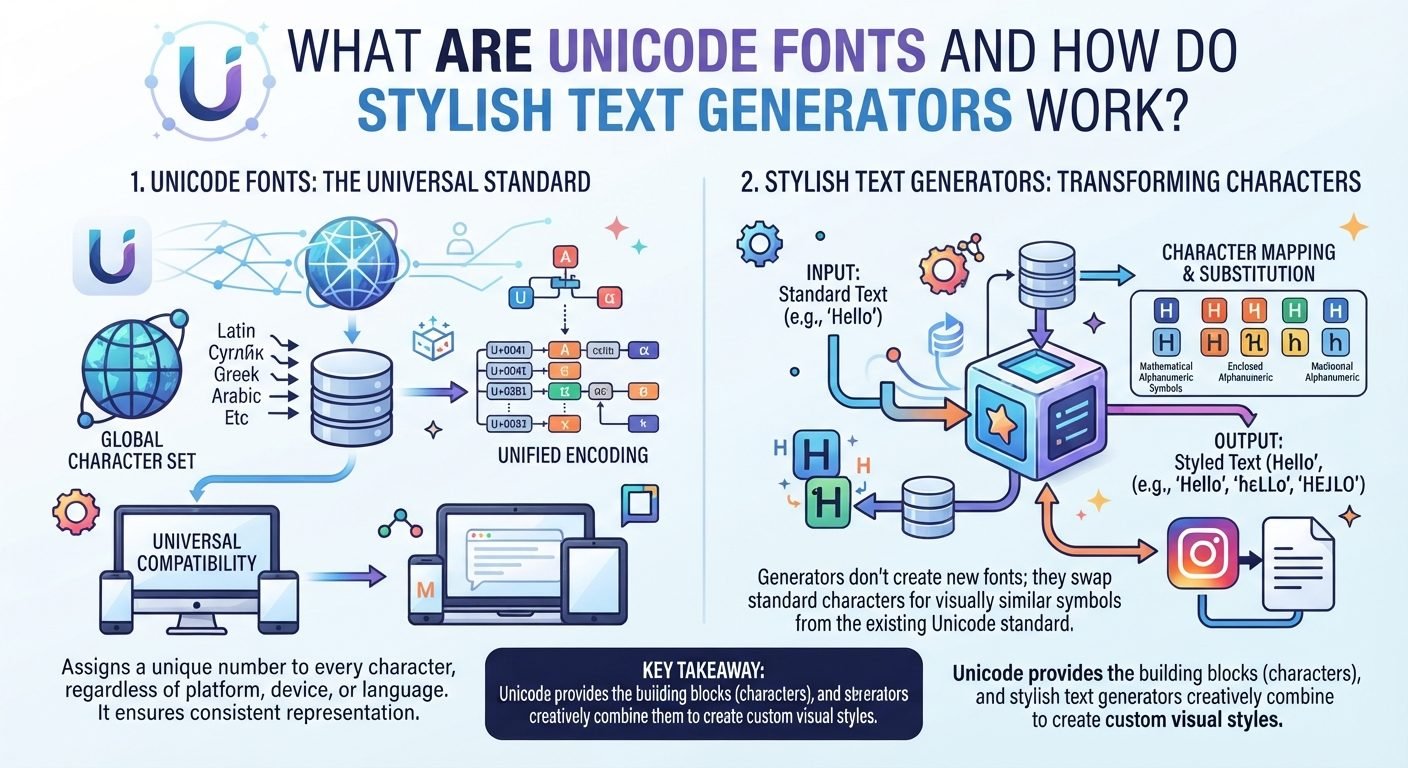
Most stylish text generators work by replacing ordinary characters with different Unicode characters that have their own visual forms. This makes it possible to copy and paste decorative text into places where traditional font formatting may not be available.
Understanding how Unicode works can help you use stylish text more effectively and avoid common problems with readability, compatibility, and searching.
Read also: → Stylish Font Generator — 50+ Unicode Fonts Free
What Is Unicode?
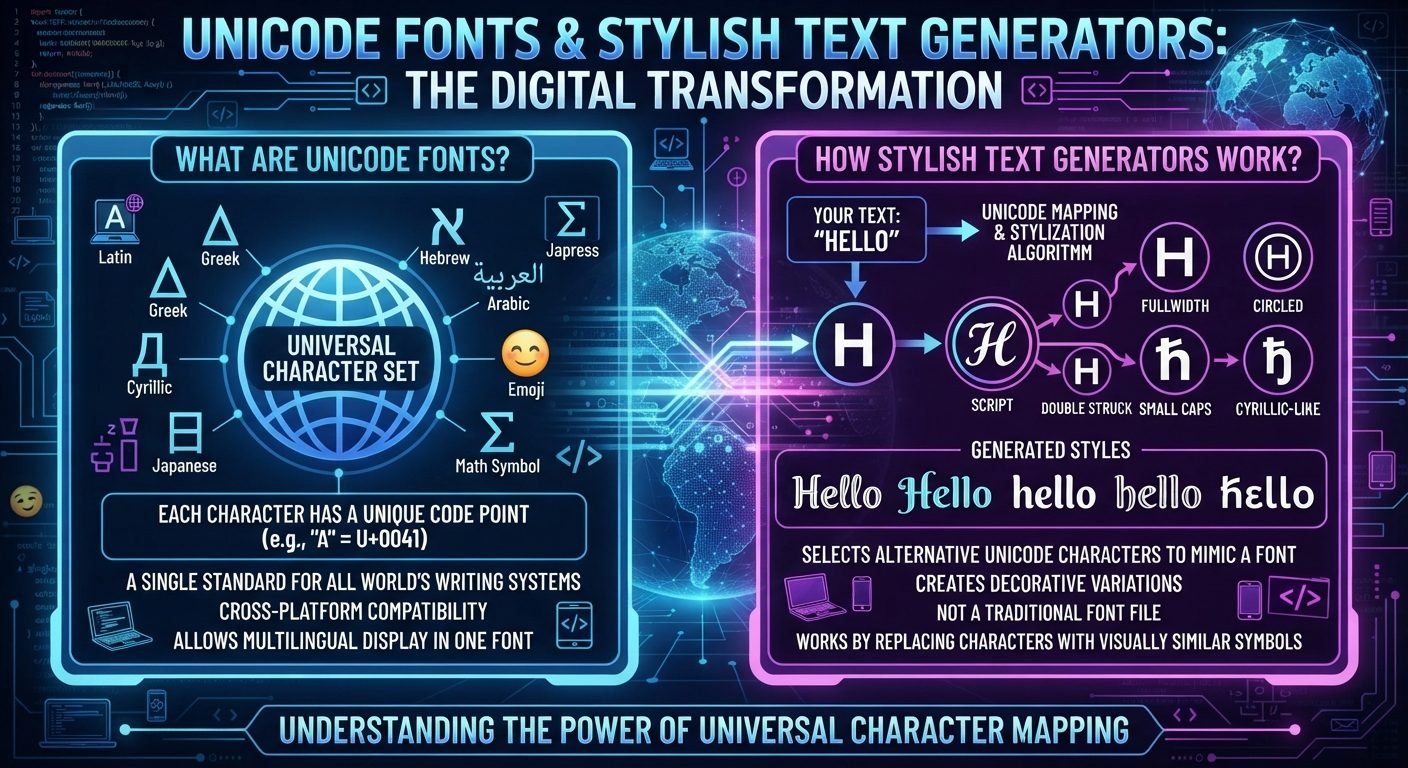
Unicode is a worldwide character-encoding standard designed to give digital text a consistent way to represent characters.
Computers do not naturally understand letters as visual shapes. They store characters as numerical values. Unicode provides standardized character assignments so that systems can represent an enormous range of writing systems, symbols, punctuation marks, and other characters.
For example, ordinary Latin letters such as:
- A
- B
- C
- D
have specific Unicode code points.
Unicode also includes characters from many other writing systems, mathematical symbols, currency symbols, punctuation, emoji, and specialized character sets.
This is one reason you can type and exchange text in many different languages across different devices and applications.
Unicode Is Not the Same as a Font
This distinction is important.
A font normally changes how a character is displayed without changing the underlying character itself.
For example, the letter:
A
can be displayed using many different fonts.
The underlying character is still the letter A.
A stylish text generator may instead produce a completely different Unicode character that visually resembles an A.
This means the text itself has changed, rather than simply changing the font used to display it.
A Simple Example
Consider the normal word:
Hello
A website could display that word using a bold font, italic font, handwritten font, or another typeface.
The underlying text would still be:
Hello
A Unicode-based stylish text generator may instead produce something like:
𝑯𝒆𝒍𝒍𝒐
Those characters are not simply ordinary letters being displayed with a different font setting. They are Unicode characters from specialized character ranges.
That distinction explains why you can often copy stylish text from a generator and paste it into a social media bio without installing a font.
What Does a Stylish Text Generator Actually Do?
A stylish text generator usually takes ordinary input and maps each character to another Unicode character.
Suppose you enter:
Nova
The generator may have a collection of character mappings.
Conceptually, it could transform:
N → 𝑵
o → 𝒐
v → 𝒗
a → 𝒂
The result becomes:
𝑵𝒐𝒗𝒂
The generator does not necessarily create a new font file. Instead, it produces a sequence of Unicode characters that already exist in the Unicode standard.
This is why the result can often be copied and pasted like ordinary text.
Why Can You Copy Stylish Text?
Because Unicode characters are still characters.
When you copy:
𝑵𝒐𝒗𝒂
you are copying the underlying Unicode characters, not a picture of the text.
The receiving application gets those characters and attempts to display them using an available font.
If the device or application has a font capable of displaying those characters, you will see the intended appearance.
This is one of the main reasons Unicode stylish text is useful for social media profiles and online names.
How Unicode Character Mapping Works
A simple stylish text generator can be thought of as a character replacement system.
Imagine a generator has a style that maps ordinary letters to mathematical bold characters.
The input might be:
Stylish Name
The generator processes the individual characters and replaces them with corresponding Unicode characters.
The result might look like:
𝐒𝐭𝐲𝐥𝐢𝐬𝐡 𝐍𝐚𝐦𝐞
A different style could produce:
𝑆𝑡𝑦𝑙𝑖𝑠ℎ 𝑁𝑎𝑚𝑒
Another might produce:
𝕊𝕥𝕪𝕝𝕚𝕤𝕙 ℕ𝕒𝕞𝕖
Each style is based on a different set of Unicode characters.
Why Do Some Unicode Styles Look Like Fonts?
Unicode contains groups of characters that were designed with particular mathematical and technical uses in mind.
Some of these characters have visual variants that resemble different typographic styles, such as bold, italic, script-like, double-struck, or monospace forms.
Because they visually resemble font variations, they are commonly used to create what people call "stylish fonts."
Technically, though, many of these generators are producing Unicode text rather than changing the font of the original text.
Not Every Stylish Character Is a Letter
Unicode contains much more than letters.
Stylish text generators may also use:
- Mathematical symbols
- Decorative punctuation
- Special spacing characters
- Arrows
- Geometric symbols
- Stars
- Lines
- Brackets
- Currency symbols
- Emoji
- Miscellaneous decorative characters
This allows generators to create designs such as:
『Nova』
★ Nova ★
✦ 𝑵𝒐𝒗𝒂 ✦
The letters and decorative elements may come from completely different parts of Unicode.
Why Do Some Letters Look Different From Others?
You may notice that a stylish text style does not transform every character perfectly.
For example, one alphabetic character may have a special Unicode variant while another does not.
This happens because Unicode does not provide a complete styled replacement for every possible character in every style.
Some mathematical alphabets contain specialized versions of many Latin letters, but certain characters may be missing or behave differently.
A generator therefore may need to use fallback characters.
This can result in a word where most letters have a decorative appearance while one or two characters look more ordinary.
Why Are Some Letters Missing From a Style?
Unicode was not designed specifically to provide decorative versions of every letter.
Many stylish text styles are based on particular Unicode character blocks that contain selected mathematical alphabets or other specialized characters.
As a result, a generator cannot always find a perfect Unicode equivalent for every input character.
For example, uppercase and lowercase letters may have different availability, while numbers and punctuation may have limited alternatives.
A good generator needs to handle these situations rather than simply producing broken or confusing text.
What Happens to Numbers?
Numbers can be more complicated than letters.
Some Unicode mathematical styles provide decorative versions of digits, while others do not.
You might enter:
Nova 2026
and receive a result where the letters change but the numbers remain ordinary.
Another style may provide different-looking digits.
This is normal and depends on which Unicode characters exist for that particular style.
Why Does Stylish Text Work Without Installing Anything?
Traditional fonts usually require the font file to be available to the device or application.
Unicode characters work differently.
The receiving system already knows the Unicode character identity. It simply needs an appropriate font to display that character.
For example, when you paste a Unicode character into a social media bio, the platform does not need to download the exact font used by the generator.
Instead, the platform renders the character using a font available to its system.
This is why Unicode stylish text can work across many websites and applications.
Why Can Stylish Text Look Different on Different Devices?
Unicode defines characters, but it does not guarantee that every device will display them with exactly the same visual design.
The appearance depends partly on the font used by the operating system, browser, application, or website.
As a result, the same Unicode text can have slightly different appearances on:
- Android phones
- iPhones
- Windows computers
- Mac computers
- Web browsers
- Gaming applications
- Messaging apps
The character remains the same, but its visual presentation can vary.
What Happens When a Device Does Not Support a Character?
If a device or application does not have an appropriate font for a Unicode character, it may display a missing-character box or another fallback symbol.
You might see something resembling:
□
instead of the intended character.
This is one of the biggest limitations of Unicode-based stylish text.
A generator cannot guarantee that every platform will support every character it produces.
Unicode and Username Restrictions
There is an important difference between display names and usernames.
A platform may allow many Unicode characters in a display name while restricting usernames to a smaller set of characters.
For example, a display name might allow:
𝑵𝒐𝒗𝒂 ✦
while the username may only allow something similar to:
@nova_2026
This is why a stylish text generator may work perfectly for a profile name but fail when you try to use the same output as a username.
Always check the platform's specific rules.
Unicode Text vs Traditional Font Formatting
The difference becomes clearer with an example.
Traditional formatting:
Hello
with bold styling means the underlying text remains "Hello," while the application changes its visual presentation.
Unicode styling:
𝐇𝐞𝐥𝐥𝐨
uses different Unicode characters that resemble bold letters.
If you copy traditional bold text from an editor, the destination application may or may not preserve the formatting depending on the context.
If you copy Unicode-styled text, the actual Unicode characters are copied.
That is why Unicode stylish text can work in places where traditional rich-text formatting is unavailable.
Why Stylish Text Generators Are Useful
Unicode generators can be useful when you want to personalize:
- Social media display names
- Profile bios
- Gaming names
- Discord names
- Captions
- Community profiles
- Online nicknames
- Decorative headings
- Messages
- Status updates
They are particularly useful on platforms that provide limited font-formatting controls.
Instead of selecting a font from a formatting menu, you can generate Unicode text and paste it directly.
The Limitations of Stylish Text Generators
Despite their usefulness, Unicode generators are not the same as real font editors.
They Cannot Guarantee Compatibility
A character that works on one platform may not display correctly on another.
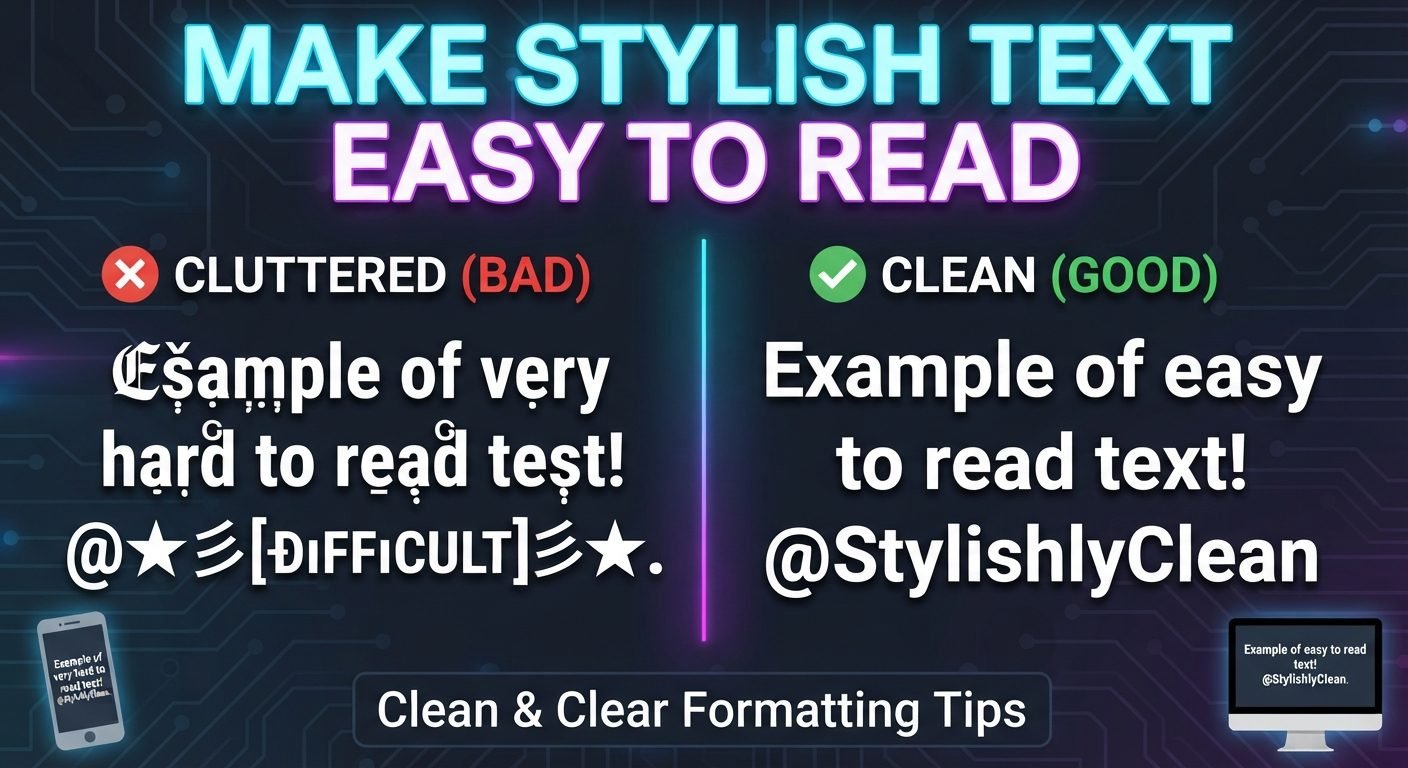
They Can Reduce Readability
Some styles are attractive but difficult to understand at a glance.
They May Not Work in Usernames
Many platforms restrict the characters allowed in account handles.
Search Can Become More Difficult
Unicode characters that look like ordinary letters are not necessarily treated as the same characters by search systems.
Accessibility Can Be Affected
Screen readers and assistive technologies may interpret unusual Unicode characters differently from ordinary text.
For important information, ordinary text is usually safer.
Why Unicode Can Affect Searching
This is an important issue for people creating social media names.
Consider:
Nova
and:
𝑵𝒐𝒗𝒂
They may look like the same word to a person, but they are made from different characters.
A search system may not always treat them as equivalent.
This means someone searching for "Nova" may not necessarily find an account whose name contains a particular Unicode-styled version.
The exact behavior depends on the platform's search system.
For this reason, it can be useful to keep your username simple even if your display name is decorative.
Unicode Can Also Affect Copying and Typing
Ordinary text is generally easy to type from a standard keyboard.
A stylish Unicode name may not be.
If someone sees:
𝕹𝖔𝖛𝖆
they may not know how to reproduce those exact characters without copying them.
This can be inconvenient when sharing an account verbally or trying to find it manually.
A simple username solves much of this problem.
How to Use Stylish Text More Effectively
A good approach is to separate visual identity from practical identification.
For example:
Display name: 𝑺𝒊𝒍𝒗𝒆𝒓 𝑵𝒐𝒗𝒂 ✦
Username: @silvernova
The display name provides the visual style.
The username provides a simple way to identify and search for the account.
This combination gives you creativity without making the entire identity dependent on unusual characters.
How to Choose a Unicode Style
Do not choose a style simply because it looks unusual.
Consider how the text performs in real use.
Check Readability
Can someone understand the name immediately?
Check the Size
Does it remain readable when displayed in a small profile area?
Check the Entire Name
Some styles look good for short words but become difficult to read when the name contains several words.
Check Numbers and Symbols
Make sure the complete name looks consistent.
Test It on Your Target Platform
Paste the text into the actual profile or application where you plan to use it.
This is more reliable than judging the text only on the generator website.
How a Basic Stylish Text Generator Could Be Built
At a technical level, a simple generator does not need to be extremely complicated.
The basic process can be:
- Receive the user's text.
- Read each character.
- Find a corresponding Unicode character in the selected style.
- Replace the original character when a mapping exists.
- Keep unsupported characters unchanged.
- Return the resulting Unicode string.
- Allow the user to copy the result.
For example, a style mapping might conceptually contain:
A → 𝐀
B → 𝐁
C → 𝐂
and so on.
When the user enters:
ABC
the generator returns:
𝐀𝐁𝐂
More advanced generators can support many styles, symbols, decorations, capitalization options, and compatibility checks.
Unicode Does Not Automatically Make Text Better
More decoration does not always mean a better result.
A simple name such as:
Nova
may be easier to remember than:
꧁༺𝓝𝓸𝓿𝓪༻꧂
The second version may be more decorative, but it also contains additional symbols that can make the actual name harder to recognize.
The best choice depends on the purpose.
A gaming nickname may tolerate more decoration than a professional profile. A username intended for searching may need to remain much simpler than a decorative display name.
When You Should Use Normal Text Instead
Unicode stylish text is not appropriate for every situation.
Normal text is usually preferable for:
- Important instructions
- Professional documents
- Accessibility-focused content
- Contact information
- Important announcements
- Long paragraphs
- Technical information
- Navigation labels
Decorative Unicode works best as an enhancement rather than a replacement for normal readable text.
The same letter, as six different characters
A generator does not style your letter; it swaps it for a different character that already exists in Unicode and happens to look styled. Seeing one letter across styles makes the mechanism concrete.
| What you type | What you get | Its real Unicode name | Code point |
|---|---|---|---|
| A | 𝐀 | Mathematical Bold Capital A | U+1D400 |
| A | 𝐴 | Mathematical Italic Capital A | U+1D434 |
| A | 𝒜 | Mathematical Script Capital A | U+1D49C |
| A | 𝔄 | Mathematical Fraktur Capital A | U+1D504 |
| A | Ⓐ | Circled Latin Capital Letter A | U+24B6 |
| A | A | Fullwidth Latin Capital Letter A | U+FF21 |
This is also the reason a styled name can fall out of search results: to a system matching text, 𝐀 and A are different characters, and only a platform that normalises them will connect the two.
Read also: → Stylish Font Generator — see all 32 alphabets at once
Frequently Asked Questions
Are Unicode fonts actually fonts?
Usually, when people say "Unicode fonts," they are referring to Unicode characters that create a font-like appearance. Unicode itself is a character standard, while a font determines how those characters are visually rendered.
Do stylish text generators create real fonts?
Most stylish text generators do not create or install a new font. They usually convert ordinary characters into different Unicode characters that have decorative appearances.
Can I copy and paste Unicode stylish text?
Yes. Unicode characters are text, so they can generally be copied and pasted like ordinary characters. Whether they display correctly depends on the destination platform and available fonts.
Why does stylish text sometimes appear as boxes?
A box or missing-character symbol can appear when the device or application cannot properly display the Unicode character.
Can Unicode stylish text be used in usernames?
Sometimes. It depends entirely on the platform's username rules. A platform may support Unicode in display names but restrict usernames to ordinary letters, numbers, and a small selection of symbols.
Is Unicode text safe to use?
Unicode text itself is a standard method of representing characters. However, unusual characters can cause readability, compatibility, search, or accessibility problems, so it is best to use them thoughtfully.
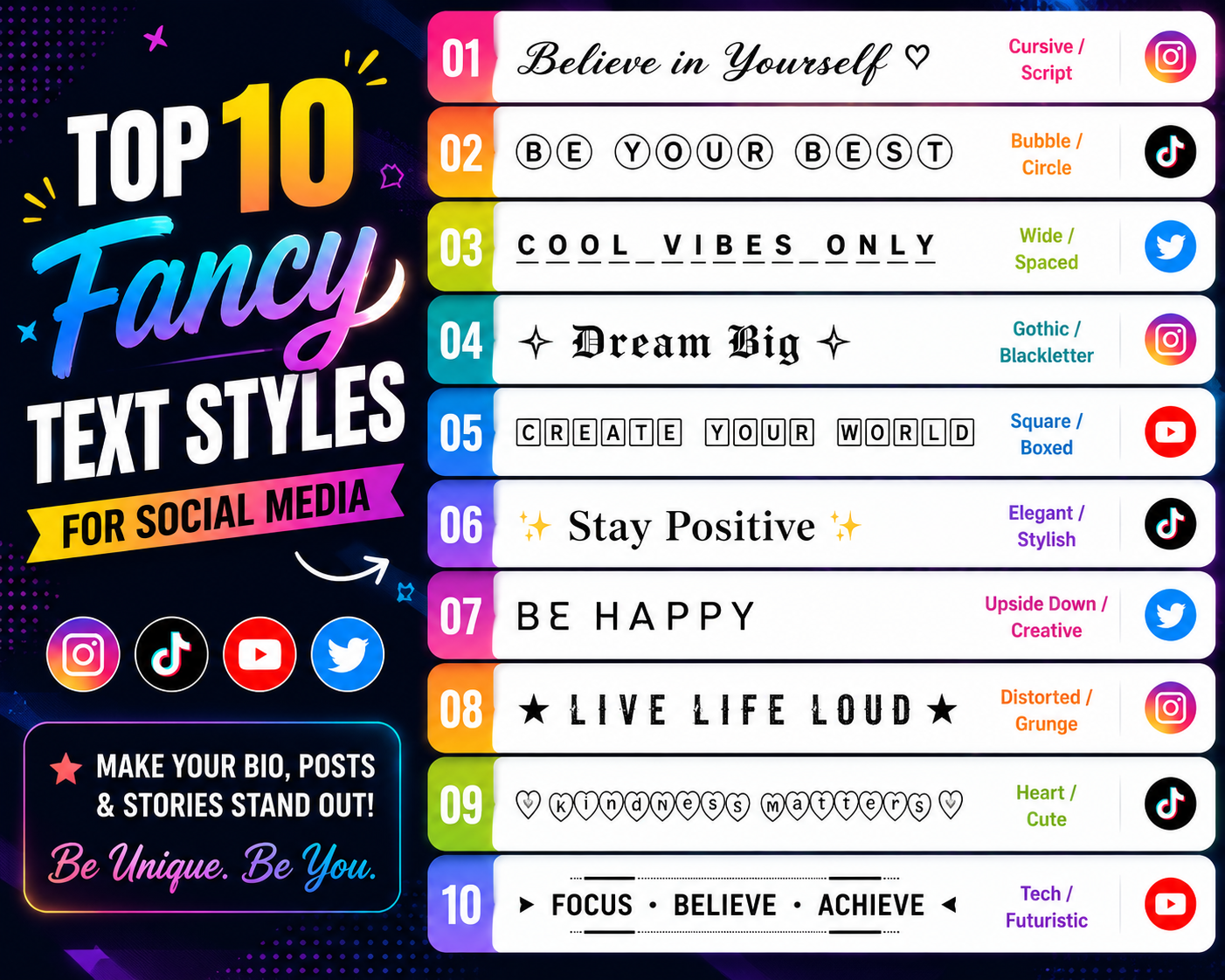
Read also: → Top 10 Fancy Text Styles for Social Media