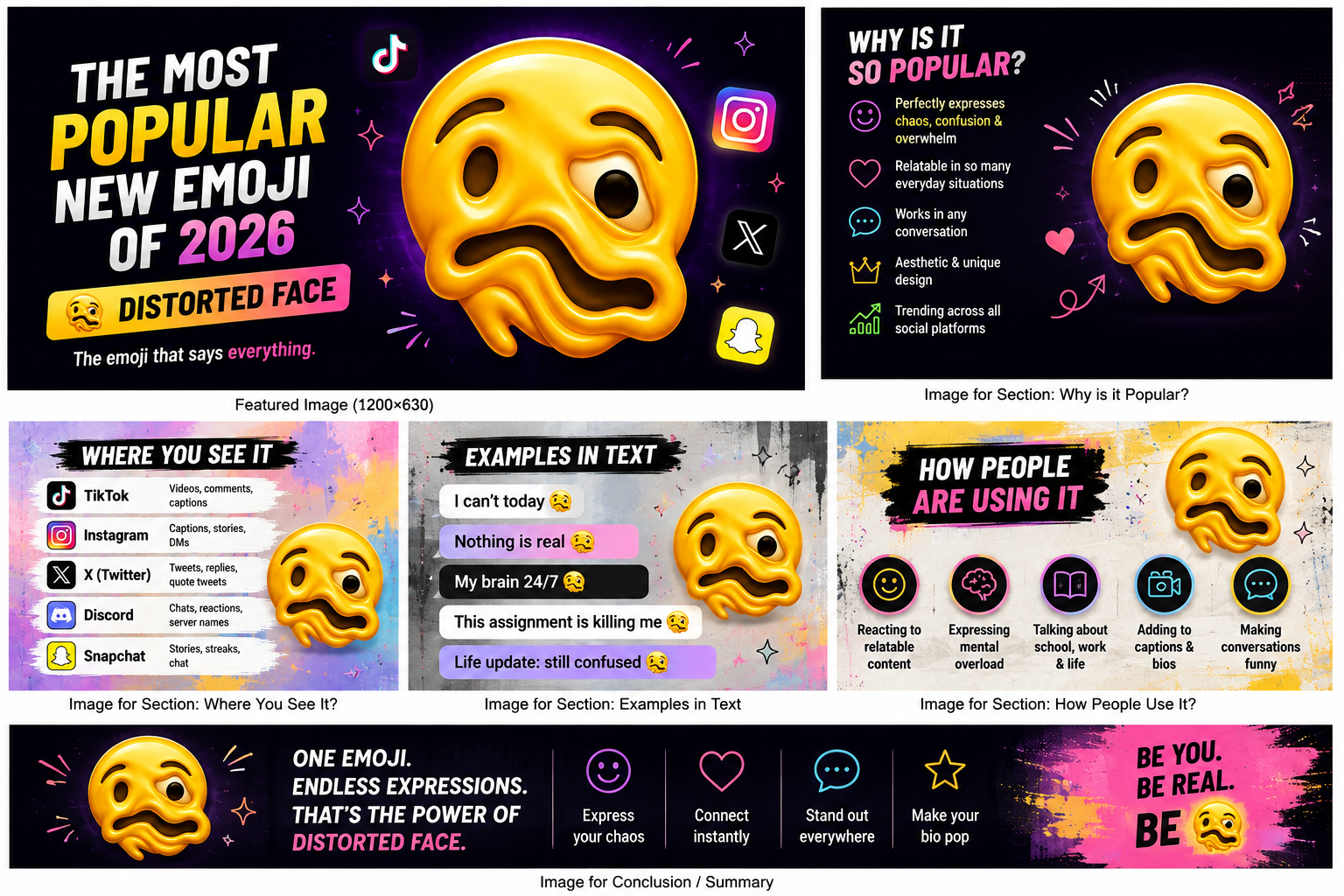
The most popular new emoji 2026 produced is Distorted Face. It took the Most Popular New Emoji award at this year's World Emoji Awards, ahead of Orca in second and Fight Cloud in third.
The most popular new emoji 2026 result is worth a closer look than a headline allows, partly because the winner is an odd-looking character with no single agreed meaning, and partly because "163 new emoji" — the figure attached to this release everywhere — describes something quite different from 163 new pictures. Both are worth unpacking.
Most Popular New Emoji 2026: What Won and What the Award Measures
Distorted Face won, and the full top five looks like this.
| Rank | Emoji | Name | Result |
|---|---|---|---|
| 1 | | Distorted Face | Winner |
| 2 | | Orca | Runner-up |
| 3 | | Fight Cloud | Third |
| 4 | 🧑🩰 | Ballet Dancer | Fourth |
| 5 | | Treasure Chest | Fifth |
Two things define what the most popular new emoji 2026 award actually measures. The first is eligibility: only emoji from the Emoji 17.0 set were in the running, so a decade-old favourite could not compete no matter how heavily it is used. The second is the data behind it — according to Emojipedia and the World Emoji Awards, the ranking draws on the site data that powers Emojitracker rather than on a public vote.
That makes it a usage measurement rather than a popularity contest, which matters when you compare it to the other awards handed out the same day. A vote measures what people say they want; usage data measures what they actually reached for. The two do not always agree, and in 2026 they did not.
Why Is Distorted Face So Popular?
Explaining why it became the most popular new emoji 2026 produced means moving from documented fact to interpretation, so it is worth being clear about which is which. The verified part is the result itself. The reasons below are reasonable readings of it, not measured findings.
One likely reason is that it does not commit to a single emotion. Most face emoji are specific — a wink means one thing, a sob means another. The distorted face is deliberately ambiguous, wobbling somewhere between shock, dread and disbelief, so it fits far more conversations than a precisely defined face does. Emoji that carry several readings at once tend to travel further than emoji that carry one.
Part of its appeal may also be visual novelty. It does not look like the rest of the smiley set. Where most faces are symmetrical and flat, this one is warped, which makes it stand out in a picker full of near-identical yellow circles and gives it an obvious use as a reaction rather than a decoration.
It is also unusually well suited to the way people talk online. A great deal of social posting runs on exaggerated reaction — to a plot twist, a price, a piece of news — and there was no established emoji for this is too much for me. The distorted face filled a gap that already existed rather than inventing a new one.
One further point is structural rather than psychological: it shipped early and broadly. An emoji that is missing on half of the devices that see it cannot accumulate usage, and this one arrived in the main vendor updates during the same window the data was gathered.
What Does the Distorted Face Emoji Mean?
There is no single official meaning, and it would be wrong to present one. Unicode's own keyword list for the character points in several directions at once — anxiety, panic, shock, surprise, feeling bloated or vulnerable — which tells you the ambiguity is built in rather than accidental.
In practice people use it for a fairly consistent cluster of feelings:
- Shock or disbelief at something unexpected, usually in a reply rather than an original post.
- Overwhelm — the emoji equivalent of a long exhale at a to-do list.
- Anxiety played for comedy, which is most of its use in meme captions.
- Absurdity, where the thing being reacted to is too ridiculous for a straightforward face.
Emoji meanings settle through use rather than decree, and this one is young enough that its meaning is still moving. The peach and the skull both drifted a long way from their original descriptions, and there is no reason to assume this character will not do the same. Treat any confident claim about what it "really" means with suspicion, including this one.
The Top 5 Most Popular New Emojis of 2026
1. Distorted Face
A yellow face pulled out of shape, as though squeezed or melting. Encoded at U+1FAEA. Its strength is range: it works as a reaction to good news, bad news and nonsense, which is unusual for a face emoji and is the most plausible explanation for it topping a usage ranking rather than a vote.
2. Orca
A killer whale in side profile, at U+1FACD. Its win is a reminder that a well-chosen animal reliably outperforms an abstract concept — the ocean set had a shark and a dolphin but nothing for the animal most people actually think of first. Useful for wildlife content, ocean posts, sports teams and anything trading on the animal's reputation.
3. Fight Cloud
The cartoon dust cloud with limbs flying out of it, at U+1FAEF. Unicode lists it against argument, brawl, debate and disagreement. It is one of the few new characters that captures a situation rather than an object or an expression, which makes it genuinely useful for describing a chaotic group chat or a comment section.
4. 🧑🩰 Ballet Dancer
Built as a sequence — a person joined to a ballet shoe (U+1F9D1 U+200D U+1FA70) — which is why it also arrives with skin tone options. It fills an obvious hole in a set that already had several other dance and sport figures, and reaches beyond dance itself into anything described as graceful or precisely executed.
5. Treasure Chest
An open chest of gold at U+1FA8E. The most literal of the five and the most flexible in practice: gaming loot, giveaways, sales, a metaphorical find. Gaming vocabulary in particular had been borrowing the money bag and the gem for years without a proper equivalent.
What New Emojis Were Added in Emoji 17.0?
This is the part that is most often reported carelessly. Emoji 17.0 was approved on 9 September 2025 and is usually described as containing 163 new emoji. That figure is correct, but Unicode counts emoji and sequences together — so it is not 163 new pictures.
Unicode's own breakdown splits those 163 into a handful of genuinely new base characters and a much larger number of sequences: gender and role variants, family and group combinations, and skin tone variations. The bulk of the total comes from roughly 150 skin tone combinations added to two existing emoji — People Wrestling and People With Bunny Ears — rather than from new artwork.
The genuinely new designs are a much shorter list:
- Distorted Face — U+1FAEA
- Orca — U+1FACD
- Fight Cloud — U+1FAEF
- 🧑🩰 Ballet Dancer — U+1F9D1 U+200D U+1FA70
- Treasure Chest — U+1FA8E
- Hairy Creature — U+1FAC8, a bigfoot or sasquatch figure
- Trombone — U+1FA8A
- Landslide — U+1F6D8
One character that was announced and then did not arrive is worth flagging, because it still appears in older write-ups: an Apple Core emoji was included in the draft list Unicode previewed in July 2025, but it was withdrawn before final approval and is in neither Unicode 17.0 nor Emoji 17.0. If you see it listed as a 2026 emoji, that source has not been updated.
When Did the New 2026 Emojis Become Available?
Knowing when the most popular new emoji 2026 winner actually reached phones means separating two stages that often get merged. Approval and availability are different things, and the gap between them is usually months. Unicode approving a character only means vendors may now draw it; nothing appears on a phone until the company that makes the phone ships a font update.
Google published its designs shortly after approval in September 2025, adding them to its Noto Color Emoji release, then rolled them out gradually across Android, Chrome OS, Gmail and YouTube through 2026. Apple's support arrived with iOS 26.4, which reached the public in spring 2026. Across the year the set also reached Samsung, WhatsApp, Discord and several open emoji projects — the roughly nine-month spread that made the usage data behind this award possible in the first place.
What this means for you is simple enough: a new emoji you can see is not necessarily a new emoji everyone can see. Someone on an older phone, or one that has not taken a recent update, will get an empty box instead. That gap narrows over a year or two but never quite closes, which is worth remembering before building a caption around a brand-new character. The emoji collection explains why the same character also looks different from one platform to the next.
Distorted Face vs Other New Emojis
A practical comparison of the five, judged on what each is actually good for.
| Emoji | Best for | Typical use | Why it stands out |
|---|---|---|---|
| | Reactions of any intensity | Replying to shocking, stressful or absurd news | The only one of the five with no fixed meaning, so it fits almost anywhere |
| | Wildlife, ocean and team content | Nature posts, aquarium visits, mascots | Fills an obvious gap in a well-used category |
| | Conflict described lightly | Group chat chaos, comment sections, sports rivalries | Captures a situation rather than an object or a face |
| 🧑🩰 | Dance, performance, precision | Recitals, training clips, anything called graceful | Sequence-built, so it carries skin tone options |
| | Rewards and finds | Loot, giveaways, sales, discoveries | The most literal, and the most reusable as metaphor |
Read also: → Emoji Collection — browse and copy every emoji by category
How to Use the New 2026 Emojis
A few patterns that work, given how each platform handles them.
- Captions. The same restraint that applies across the major platforms applies here: one reaction emoji at the end of a line does more than three in the middle of it. after a genuinely surprising statement reads as tone; three in a row reads as noise.
- Bios. Treat a new emoji as punctuation between ideas rather than decoration. The TikTok bio guide and the Instagram bio guide both cover how much decoration a short profile field can carry before it stops being readable.
- Replies and comments. Where is strongest — a reaction needs no context because the thing being reacted to is right above it.
- Messaging and Discord. Safe with people whose phones you know are current; less safe in a large group where someone is on an older device. Discord renders new emoji quickly but its members are on a wide spread of devices.
- Gaming chat. has an obvious job around loot and rewards, though many games strip or reject emoji in names and chat entirely — gaming symbols covers what actually survives those fields.
If a character shows as a box for the people you are talking to, the fix is not a different app but an older emoji. Anything from the last few years is far safer, and the symbols library holds text characters that render more consistently than new emoji do, and styled text is another way to add visual interest without depending on a font update.
Most Popular New Emoji vs Most Anticipated Emoji
The most popular new emoji 2026 award and the Most Anticipated award are handed out together and are constantly mixed up, so it is worth separating them properly — they measure different things, about different sets of emoji, at different points in their life.
| Most Popular New Emoji | Most Anticipated Emoji | |
|---|---|---|
| Measures | Actual usage data | Public voting |
| Which emoji | Emoji 17.0 — already released | Emoji 18.0 — still a draft |
| 2026 winner | Distorted Face | Cracking Face |
| Status | On phones now | Not yet approved |
So the 2026 Most Anticipated winner, the Cracking Face, is not a rival to the Distorted Face — it is not even in the same release. It belongs to the Emoji 18.0 candidate list, a much smaller batch of around nineteen draft emoji expected to go before Unicode for approval in September 2026, which on the usual timeline means most people would not see them until 2027.
There is a further wrinkle worth knowing, because it is the single easiest fact to get wrong here: the Distorted Face itself won the Most Anticipated award back in 2025, before it existed on anyone's phone. Winning both — anticipation first, then usage a year later — is unusual, and it is why the same emoji turns up in coverage of two different awards from two different years.
Is Distorted Face the Most Popular Emoji Overall?
No. It is the most popular new emoji of 2026, which is a much narrower claim, and the difference matters.
The most popular new emoji 2026 title only ever considered the Emoji 17.0 additions. Emoji that have been in keyboards for a decade were not eligible, and the long-running favourites — the laughing-crying face, the red heart and the rest — remain far ahead of any 2025-approved character by total use. A character released partway through the measurement window cannot out-accumulate one that has been available since 2010, and this award does not ask it to.
The accurate way to state the result is that among emoji new enough to be eligible, this one was used most. Any headline suggesting it is now the world's favourite emoji has dropped the word that carries all the meaning.
Frequently Asked Questions
What is the most popular new emoji of 2026?
The most popular new emoji 2026 delivered is the Distorted Face (), which took the award for that year, followed by the Orca, the Fight Cloud, the Ballet Dancer and the Treasure Chest. The ranking covers only emoji from the Emoji 17.0 release.
What does the emoji mean?
There is no single official meaning. Unicode associates it with anxiety, panic, shock and surprise, and in practice people use it for disbelief, overwhelm or comic absurdity. Its vagueness is a large part of why it gets used so widely.
Why is the distorted face emoji popular?
The award is based on usage data rather than stated reasons, so any explanation is interpretation. The most plausible one is that it carries several emotions at once and looks unlike the rest of the smiley set, which makes it useful as a general-purpose reaction.
What are the top new emojis of 2026?
In award order: Distorted Face, Orca (), Fight Cloud (), Ballet Dancer (🧑🩰) and Treasure Chest (). The wider Emoji 17.0 release also added a Hairy Creature, a Trombone and a Landslide.
How many new emoji are in Emoji 17.0?
Unicode gives the figure as 163, but that counts emoji and sequences together. Only a handful are new designs; most of the total comes from skin tone and gender combinations, including around 150 skin tone variants added to two existing emoji.
When were the new 2026 emojis released?
Unicode approved them in September 2025. Google published designs shortly afterwards and rolled them out through 2026, and Apple added support in iOS 26.4 in spring 2026. Approval and availability on a given phone are separate stages.
Is the distorted face emoji available on iPhone and Android?
On current versions, yes — it arrived on Apple devices with iOS 26.4 and on Google platforms through their 2026 updates. Devices that have not taken a recent update will show an empty box instead.
What was the most anticipated emoji of 2026?
The Cracking Face won that vote, but it belongs to the Emoji 18.0 draft list rather than the released set. It is decided by public voting, while the Most Popular New Emoji award is decided by usage data.
Is the distorted face the most used emoji overall?
No. It won only among emoji new enough to be eligible. Long-established favourites are used far more often, and this award never compared against them.
Can I copy and paste the new 2026 emojis?
Yes — they are ordinary Unicode characters, so they copy and paste like any other text. Whether they display depends on the device receiving them having a font that includes them.